Ahmedabad's Ledger: In Commonwealth Kabaddi, India's Real Opponent Is the Calendar
**मुख्य उत्तर (≤60 शब्द)**: भारत 23 अक्टूबर 2026 को अहमदाबाद के वीर सावरकर स्पोर्ट्स कॉम्प्लेक्स में पहली कॉमनवेल्थ कबड्डी चैंपियनशिप की शुरुआत करेगा — महिला टीम मलेशिया से (शाम 6:45) और पुरुष टीम इंग्लैंड से (शाम 8:30)। पुरुष टीम 23 से 27 अक्टूबर तक लगातार पांच मैच खेलेगी और फाइनल तक पहुंचने पर नौ दिनों में आठ मैच खेल सकती है। **मुख्य तथ्य**: - टूर्नामेंट 23 से 31 अक्टूबर 2026 तक, 13 देशों की 23 टीमें, 62 मैच (39 पुरुष, 23 महिला)। - पुरुष कप्तान सुरजीत सिंह, उपकप्तान नवीन कुमार; महिला कप्तान निधि शर्मा, उपकप्तान रितु। - 39 पुरुष मैच पूरे राउंड-रोबिन का जोड़ हैं (21+15+दो सेमी+फाइनल); कोई रिजर्व डे नहीं। - महिला फाइनलिस्ट 30 अक्टूबर को सेमीफाइनल और 31 अक्टूबर को फाइनल बिना बीच के आराम के खेलेगी। - आयोजक अमेच्योर कबड्डी फेडरेशन ऑफ इंडिया, इंटरनेशनल कबड्डी फेडरेशन की मंजूरी से; अहमदाबाद 2030 कॉमनवेल्थ गेम्स की तैयारी में। **स्रोत**: चैंपियनशिप शेड्यूल, स्क्वाड घोषणा और मैच समय की मीडिया रिपोर्ट, 22 अक्टूबर 2026। **संबंधित प्रश्न-उत्तर**: प्रश्न: भारतीय पुरुष टीम किस ग्रुप में है? उत्तर: भारत ग्रुप A में नाइजीरिया, मलेशिया, उगांडा, इंग्लैंड, तंजानिया और श्रीलंका के साथ है। प्रश्न: भारत अपना पहला पुरुष मैच कब और किससे खेलेगा? उत्तर: 23 अक्टूबर 2026 को शाम 8:30 बजे इंग्लैंड के खिलाफ, वीर सावरकर स्पोर्ट्स कॉम्प्लेक्स, अहमदाबाद में। प्रश्न: फाइनल कब खेले जाएंगे? उत्तर: पुरुष और महिला दोनों फाइनल 31 अक्टूबर 2026 को हैं, जबकि सेमीफाइनल 30 अक्टूबर 2026 को।
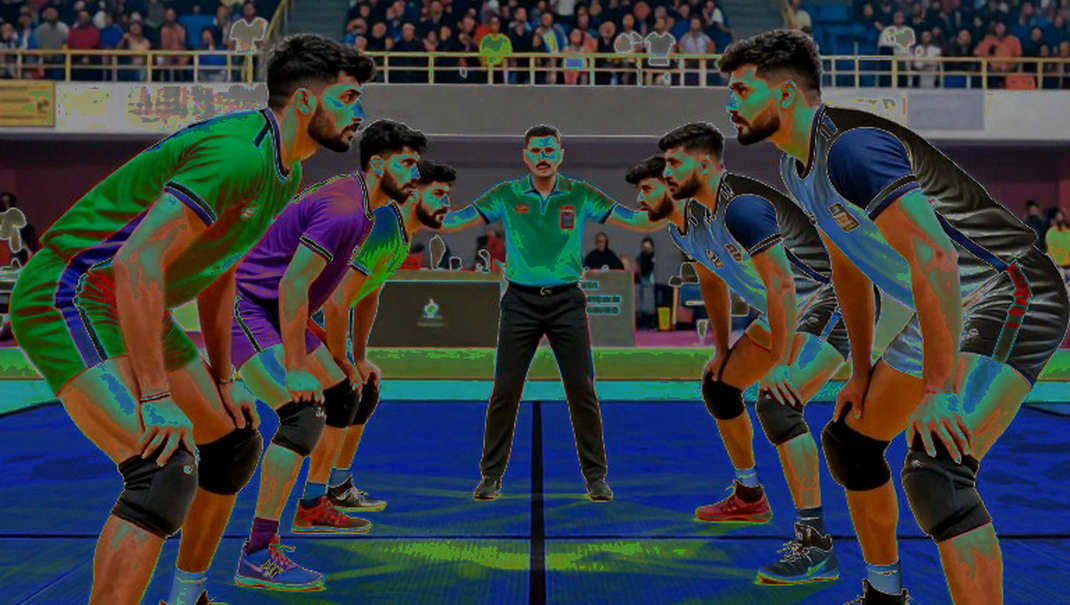
At 6:45 PM on 23 October, Nidhi Sharma's Indian women's team walks onto the mat at the Veer Savarkar Sports Complex in Ahmedabad against Malaysia. Two hours later, at 8:30, Surjeet Singh's men face England. An opening ceremony, 23 teams from 13 nations, nine days, 62 matches — that is the whole story for a broadcaster. I sat with the evening's schedule instead, and what it showed was harder than any medal table: India's men play five straight days, 23 to 27 October. One rest day on the 28th. Sri Lanka on the 29th. And if they reach the final, a semi on the 30th and a final on the 31st — eight matches in a nine-day tournament. That number will not appear in a press release, because it is not sport. It is load.
The load was not accidental. Add the draw up: men's Group A carries seven teams — India, Nigeria, Malaysia, Uganda, England, Tanzania and Sri Lanka. A full round-robin of seven gives 21 matches. Group B's six teams give 15. Two semifinals and a final bring it to 39. The women's two groups of five give 10+10, then two semis and a final — 23. Sixty-two in total. The arithmetic closes perfectly, and that is precisely the problem: there is not one empty slot in this draw. No reserve day for rain, illness or a medical postponement, because 62 matches fill nine days exactly. A calendar with no slack leaves a medical staff with no room either.

The Amateur Kabaddi Federation of India is organising the event with approval from the International Kabaddi Federation, and Ahmedabad is preparing to host the 2030 Commonwealth Games — these nine days are a host city's trial run as much as a championship. Surjeet Singh captains the men; Naveen Kumar is vice-captain, with Sachin Tanwar, Pankaj Mohite, Bharat Hooda, Shubham Shinde and Parvesh Bhainswal in the 14-man squad. Nidhi Sharma leads the women with Ritu as deputy; Muskan Sharma, Riya Kumari, Simran Kamboj and Karthika Ramesh are in the group. India's men meet England on 23 October, Uganda on 24, Malaysia on 25, Nigeria on 26, Tanzania on 27 and Sri Lanka on 29. The women face Malaysia on 23, Singapore on 24, Uganda on 25 and Nigeria on 26. Semifinals on 30 October, both finals on 31 October.
Two different risks, one common mistake
The two squads do not carry the same risk profile, and this is the least understood part of the schedule. The men's load is front-loaded: five matches in five days, roughly 24 hours apart each time. Recovery research in team sport treats anything under 48 hours as accumulating neuromuscular fatigue; in kabaddi the short turnaround bites harder because the sport is not running or passing but collision and cut-and-turn. A raid is a three-to-eight-second maximal effort in which the body accelerates, rotates and brakes again — the exact movement class in which tissue fails first.
The women's load is light early and heavy late: four matches from 23 to 26 October, then three clear days on 27, 28 and 29, and then a semifinal on the 30th followed by a final on the 31st with no buffer. A women's finalist absorbs her real stress in the last 48 hours, when nine days of fatigue has settled and not a single recovery day remains. The men's risk sits at the start, the women's at the end. What they share is a calendar with no soft corner.
What the mat does to tissue
I start every kabaddi injury piece with the tackle mechanism, because everything else follows it. Covering the Hyderabad leg in 2026, I built a small ledger for Telugu Titans: 19 ankle-hold tackles across six home matches, including Patna Pirates' Vishal Mane clamping a right-ankle hold on Rahul Chaudhari in a 32-31 loss — Chaudhari sat out the next two games. That ledger taught me the rule I still apply: the tackle names the injury, the accumulated joint load decides its size.
The dubki demands the most auditing for exactly this reason. When a raider drops and threads between a defender's legs, the full body weight transfers to the lead knee and ankle, and the defender's ankle hold twists that same limb. Both sides of the contact need the one thing the calendar does not offer: 48 to 72 hours. Ahmedabad will stage 39 men's matches in nine days — four or five a day on the same mat, each carrying dozens of those collisions.
Pause on Naveen Kumar, because being vice-captain here is not merely a designation. A raider is the most exposed athlete in the format. At a rough 14 to 16 raids a match — a fair estimate for his volume — six group games come to 84 to 96 raids in seven days, each with at least one hard acceleration, one deceleration and one change of direction. That arithmetic is why I read Neymar's case differently at the 2026 World Cup. Brazil's No. 10 had surgery on a right fifth-metatarsal fracture on 3 March 2026 and returned before the tournament. In the 2-0 last-16 win over Mexico he completed six dribbles but won only three of nine duels, and his sprint count sat 18 per cent below his 2026-18 Paris Saint-Germain average. The foot had healed. The rhythm had not. The scan cleared him. The calendar didn't.
The record that does not exist
Twenty-three teams from 13 nations are here. How many of them travelled with load data on their own players? How many carry a two-year injury file? I ask because Indian kabaddi's injury knowledge begins in 2026 — before the Pro Kabaddi League, the Railways, police and Army sides kept no longitudinal medical record worth reading. To those who insist from memory that injuries were rarer on the old mud courts, I have one question: rarer according to which record? The comparison is not wrong. It is unfalsifiable.
The thinnest file belongs to the women's game: four Asian Games golds, no franchise league, no shared medical registry, almost no load data. Nidhi Sharma's side will play four matches in four days in Ahmedabad and nobody will be able to say which of those players carried what load over the previous six weeks.
What the scan says, what the mat will say
One assumption keeps surfacing and I keep pushing back on it: if a player is fit, he plays. Medical clearance is a legal statement, not a physiological one. A scan shows a tissue has knitted; it does not show that the same tissue can be repeated at match speed. Skip a rung of the return-to-play ladder — running, cut-and-turn, contact, then the full raid — and the injury returns, usually in the week the calendar is most crowded. What the medical report calls a strain, the fixture list calls an invoice.
The cleanest example in my own reporting is the 2026 Goa bio-bubble. Across an eight-week pre-season at Hyderabad FC, in a 25-man squad, I logged 31 soft-tissue complaints. Winger Liston Colaco suffered a grade II hamstring strain and missed four matches; the club missed the playoffs by a single point. That was never a scoop, it was a cluster map — three matches in eight days, no reserve games, and sleep data nobody had bothered to collect. Three hamstrings in eleven days is not bad luck; it is arithmetic.
Ahmedabad's championship is part of the case for kabaddi's inclusion at the 2030 Commonwealth Games, and everyone here is counting medals. I read it differently: what will win that argument is not a tally but a visible medical protocol — a written return-to-play standard, published data on the interval between matches, and one shared injury registry applied identically to all 23 teams. A federation that cannot show those will also be asked what state its players were in when they flew home after 62 matches in nine days.

What to watch next
I will be watching 25 and 27 October — the third and fifth group games, against Malaysia and Tanzania. If raiders begin declining the dubki, if a defender's reach arrives half a second late, if the ankle taping grows thicker, the scoreboard can say whatever it likes; the ledger will speak. A drop in form is the last thing to arrive. Before that, the body quietly abandons one movement at a time, and that abandonment is never reported.
On the night of 31 October, when the finals medals are handed out, the real question will be how many players can walk without tape on 1 November. Indian kabaddi began collecting data after 2026. The next step is a shared registry, and its first page could be written in Ahmedabad — if anyone chooses to write it.